Neon Lighting of the 21st century Business Temple.
The last 50 years have tracked the death of individuality as dividuality takes hold. Individuals die as psychiatry structures them into networks of psychological parts. Moreover, they are killed as trends proliferate through organising bodies – the media, advertisement, sorting algorithms – make masses, define collectives, mobilise them for profit.
Psychiatry, “Big Data”, are both elements of what Deleuze calls the Control Society. Unlike previous technologies of social cohesion, this latest development works off of systematic direction of divisible processes, rather than the direction of the individual as a whole, or their termination. No more do we live in a world of atomised individuals, instead what was previously thought of as ‘indivisible’ has been separated out into a series of allegedly discrete strands. The fundamental building block of the renaissance – the liberal atom, the human, the individual – has been split into basic passwords and access codes that permit fluid participation in society – subscriptions, IDs, credit scores, an ever-growing list of qualifications, and Sainsbury’s Nectar Points. The individual has been divided, through sorting processes and algorithims. We call this process ‘dividualisation’ – a finer comb through which systemic Control is allowed to manifest. It is for this, by way of marketing, analytics, social organising, that our data is so important to the broader Neoliberal ‘Order’.
Through the Control Society, businesses, like individuals, are dividualised. They are not single shops, nor do they have individual owners – they are masses of products, collections of data manifest through shelves of items “for sale”. In the newly-fledged ‘Service Economies’ of the old Imperial Core the firm has replaced the factory. And, where the factory was built of brick walls and disciplinary management, hammering a disorganised mass of bodies into a hardened, compliant workforce, the newly-crowned firm is soft and non-corporeal, operating no longer through ‘workers’ but through ‘employees’ and ‘partners’, and utilising soft forms of disseminated Control – administrative permissions, performance reviews, and perpetual training. Power is increasingly subtle, but that’s what makes it so all-encompassing.
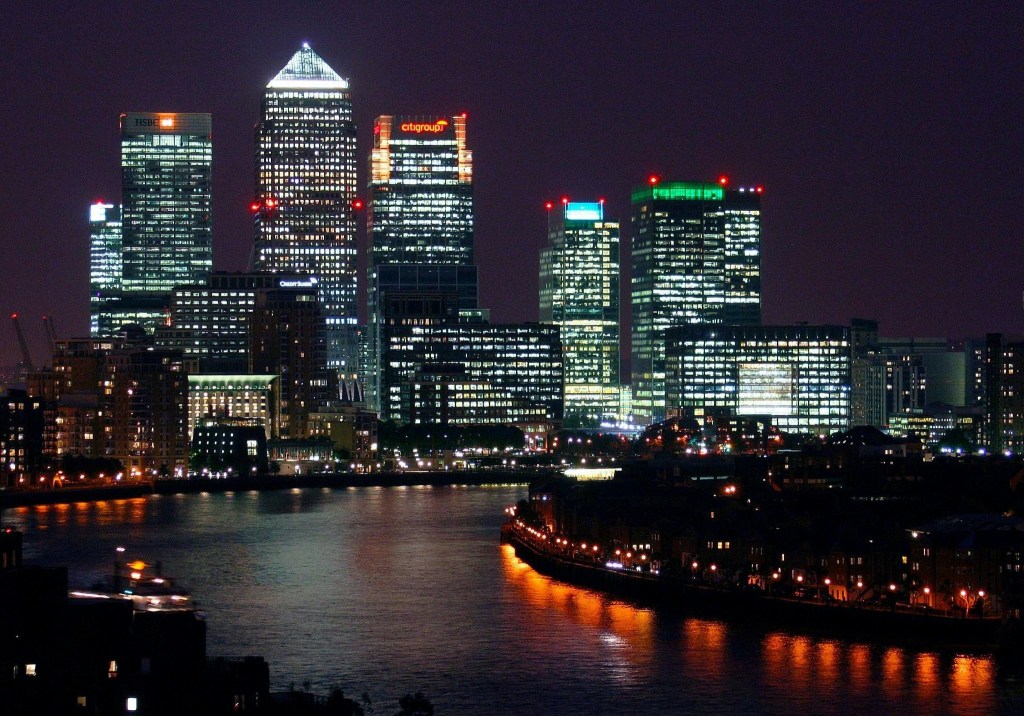
[Individual businesses die as the rivers of capital coagulate into firms.]
“For sale” is an act of data transfer. With every subsequent advancement, production mirrors its produce. Where the Disciplinary Society of the 20th century mirrored the industrial machine, the Control Society of the 21st century mirrors the digital machine.
That is, where before workers were molded through the Disciplinary architecture of schooling and conveyorised, en masse, into factory work – now they are encouraged to produce infinitely from the get-go, their creativity funnelled, harnessed and redirected. The central organising tenet of development in neoliberal capitalism is constant self-optimisation, and control over the self in minute detail. The new ‘employee’ no longer uses their body and mind to assemble a product, but instead sells their energy itself as the product. That is, something of the worker themselves is turned into liquid capital – themselves, like their produce, digitised – a continuous mass of data.
With each successive stage, society has dissolved a little more – boundaries liquidated, turned into Capital. But this is nothing to mourn. The world at large has always existed in a state of flux, beyond adequate definition or structure. Historical attempts at social organisation – sexual politics, organised religion, economic planning – have always fallen through because they were attempts to organise what is fundamentally unorganisable – a primordial chaos – something too impermanent, too complex to ever be shaped by mere human hands. That is, academic mappings of ‘how-the-world-works’ – economics, politics – were only ever incomplete expressions of a world beyond our senses – attempts to grasp at something intangible, frozen in time and sketched onto paper.
Positive or negative, push or pull, there is one fundamental law – it is change, it is movement. Capital is simply a new code for this force, an attempt to quantify qualitative experience. Capital – stocks, shares, valuations, bank balances and cost-benefit analyses – are a reduction of multifaceted experience in real-time – a continual flattening of all experience into one, measurable, fungible dimension. The currents that this data transfer track are rapid, and in a constant state of movement. The neon signs of business that litter our grey concrete skylines are images caught in the flow – new visuals for an old phenomena.
Where digital financial infrastructure makes the arteries, businesses are blood clots – waiting to be cleared. Warehouses, supermarkets, coffeeshops and restaurants collect masses of products but die if they are not sold, swept away by the undertow of constant running costs – a perpetual movement. The fundamental irony of every firm is that they rely on acquiring, creating and stocking, permanent physical objects – distillations of a zeitgeist of social desires guided by market analytics – only to require their swift ejection and evacuation as soon as possible. The best shop is one that is constantly being emptied, one that is locked in the eternal game of Operation, one that is never empty, and very rarely full. This constant intangible movement leaves behind it, a trail of stale artefacts and petrified trends – from the fossils of infrastructure and buildings that have been decaying since they were built, to plastic toys and once-loved objects of mass production. All such products are dividual masses – metaphysical objects manifest and frozen in space and time, left to litter the material world.
Capital creates its own crystallisation, but requires its own dissolution. Even social phenomena such as Queerness, class and race are required to structure capitalism – to fill out social architecture, to make marketable identities, or to capture energy – but must, at the same time, be dissolved in order to make way for new categories, alleviate internal contradictions, and maximise efficiency through liquidity. Where Capital becomes fixed, it becomes stale and breaks down on its own, new dissolution only providing more potential avenues for investment, new opportunities for recuperation and market forces once again – like carbon capture, attempts to distil gas into something permanent.
Like a parasite, Capital latches onto the living. It controls life, but, on its own, is unable to administer death – at least whilst unembued with Sovereign power. But through deciding which information lives and dies, through algorithmically sorting through paradigms of investment and divestment, Capital creates a new Necropolitics.
If it has not been already, this will be the next social technology of capitalism. But where economic utility has been the underlying justification before, I am sure it will be again.
The truth is, there were never such things as individuals, and moreover, never such things as dividuals. Both are fictions made real – convenient productions for an increasingly inhuman system – enclosures. What we mourn is not the loss of enclosures, but the creation of new ones, and increasingly minute, and precise ones at that. The creation of enclosures is not real creation, but a death in itself – something stifling and repressive, uncreative and unfree – an anti-life. This is, as it has ever been, a war against crystallisation.
Image from Pexels.com.
 The POSTLIMINARY
Leave a comment